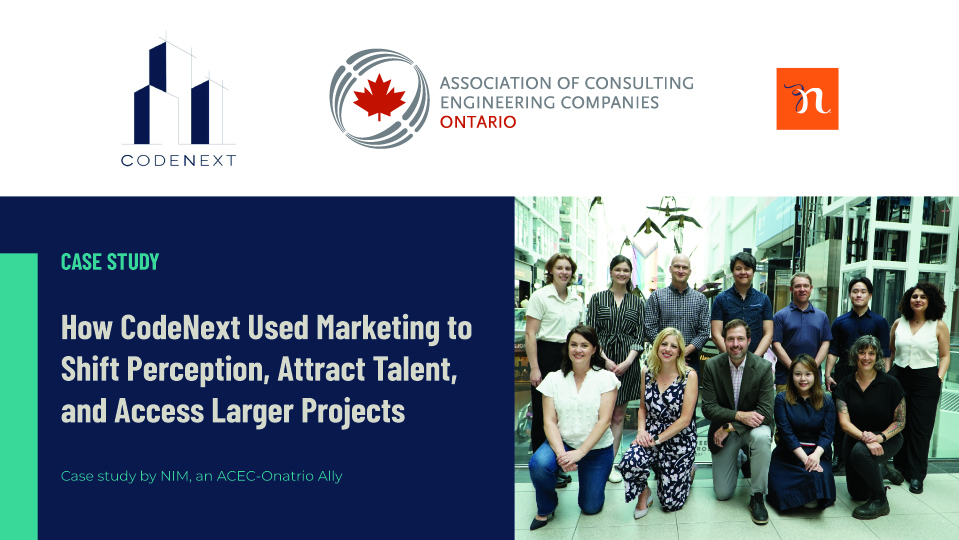
Founded in 2017, CodeNext operates in the specialized area of life safety consulting, including Building Code and Fire Code analysis, accessibility reviews, and the design of fire alarm and sprinkler systems. The firm supports architects, owners, and design teams on projects where regulatory compliance and public safety are critical.
Like many consulting engineering firms, CodeNext grew organically in its early years. Reputation, responsiveness, and relationships drove initial momentum. According to Gerry Bourne, P.Eng., Partner at CodeNext, the firm’s early success was built on being practical, accessible, and easy to work with.
“We really did rely on that in the beginning. One project would go well, and somehow that person would tell someone else.”
Industry events, particularly those attended by architects, played an important role. Building Code consulting is a niche discipline, but one that architects in major centres understand and turn to when projects become complex. Being visible and approachable allowed CodeNext to earn trust and build a steady stream of work.
This approach sustained the firm through its early growth. However, as CodeNext matured, its leadership began to recognize that organic growth alone was no longer sufficient.
When Organic Growth Was No Longer Enough
As the firm grew, CodeNext experimented with basic digital marketing, including maintaining a website and running Google Ads. While these efforts increased inbound inquiries, they also exposed a problem.
The volume of work generated from the Google Ads did not align with the type of projects the firm wanted to prioritise long term. Much of the inbound work was transactional, smaller in scale, or misaligned with the expertise and ambitions of the team. Internally, this affected morale. Externally, it did little to position CodeNext as a firm capable of handling larger, more complex work.
A defining moment came when CodeNext attempted to pursue a major project where its internal expertise was strong, but its external perception fell short.
“We didn’t even get a seat at the table. We were seen as the smaller, newer firm that couldn’t handle it, which was the opposite of the truth.”
Despite having team members with direct experience in similar facilities as this project called for, CodeNext was excluded in favour of larger, more established firms. That experience forced a hard realization: technical capability alone was not enough. The firm’s external positioning was not accurately reflecting who it was or what it could do.
A Structured Entry Point into Marketing
The catalyst for change came through participation in the Canadian Digital Adoption Program (CDAP). Initially, Bourne viewed the program as a way to improve digital tools. Instead, the audit identified a more fundamental issue: the absence of a clear, articulated marketing strategy.
That recommendation reframed marketing from a tactical activity to a strategic one. CodeNext decided to engage external support to develop a deliberate, structured approach.
The selection process to find a suitable marketing firm was pragmatic rather than exhaustive. Gerry and his business partner (Megan Nicoletti) relied on a trusted recommendation rather than a formal procurement exercise.
“It was fit, vibes, and recommendation. I didn’t know enough about marketing to create a complicated decision matrix.”
At that stage, deep industry specialization in engineering was less important than trust, alignment, and a sense that the marketing firm understood how small professional services businesses grow.
Learning What Actually Made CodeNext Different
What distinguished the early stages of the engagement was not the production of visible marketing assets, but the depth of discovery the marketing team led that took place before any execution decisions were made.
Rather than starting with a website or social media plan, the marketing team focused on understanding how CodeNext actually operated and how it was experienced by others. This work centred on structured employee interviews and client interviews conducted independently, without CodeNext leadership present.
These interviews were not validation exercises. They were designed to surface patterns in perception, language, and behaviour: why clients chose CodeNext, why they stayed, what should change, what could improve and what employees valued most about working there.
“We learned things about ourselves that we hadn’t taken the time to learn before.”
The interviews revealed that CodeNext was already differentiated in meaningful ways. Clients consistently described trust, responsiveness, and practical expertise. Employees reflected a strong cultural alignment around flexibility, professionalism, and respect. Importantly, many external stakeholders assumed CodeNext was larger and more established than it actually was.
This insight became foundational. It highlighted a disconnect between reality and representation. CodeNext was being experienced one way, but describing itself another.
The discovery process also reframed branding discussions. Rather than being about aesthetics or visual refreshes, branding became a question of accuracy: were the firm’s words, tone, and messaging clearly expressing who it was and what it did best?
Bourne acknowledges that this stage was personally challenging.
“Letting go of my being in charge of marketing for our company took longer than it should have. It was scary.”
However, grounding decisions in real feedback from employees and clients removed subjectivity. The resulting rebrand, including a new website and visual identity, was not about looking different, but about using the right words to express the truth of the firm.
From Strategy…
By the end of the strategy phase, it was clear that the most valuable work had occurred before anything visible was produced. The real shift came from clarity: clarity about positioning, language, and perception.
At that point, CodeNext made a deliberate decision. Rather than treating the strategy as a one-time exercise and then handing execution to a web designer or managing it internally, the firm retained the marketing consultancy as its external marketing team.
This decision reflected the complexity of what had been uncovered. Translating insight into positioning required discipline around language across every touchpoint: website copy, social posts, video messaging, recruitment communications, and internal alignment.
“I originally thought the strategy was all I was going to need. But once we saw how much work there actually was, and how interconnected it all was, it became obvious that this wasn’t something we could just bolt on internally.”
To an External Marketing Team
Rather than hiring in-house, CodeNext chose to keep marketing external. The discipline of marketing was unfamiliar, the learning curve was steep, and leadership time was already stretched across operations, people, and growth. Attempting to hire internally without a clear understanding of what effective marketing actually looked like would have introduced risk and rework.
Because the external marketing firm had already conducted the employee and client interviews and developed the positioning, they were uniquely positioned to carry that insight into execution. The same thinking informed the website copy, social content, video messaging, and recruitment materials.
Execution was no longer fragmented or cosmetic. Every visible output reinforced the same core story about who CodeNext was, what it did best, and why clients and employees stayed.
“There was a time when the company’s marketing took a lot of my attention. Now I look at it as something we built properly, and it just runs.”
In many ways, the decision mirrored how CodeNext’s own clients engage the firm. Architects and owners do not hire Building Code or life safety consultants because they lack intelligence or capability. They do so because specialized expertise reduces risk, accelerates outcomes, and avoids costly missteps. CodeNext recognized that marketing functioned in much the same way.
Changes That Were Visible Before They Were Measurable
Since formalizing its marketing approach, CodeNext has expanded geographically, diversified its project portfolio, and increased its presence in sectors it had previously struggled to access.
The most noticeable shift, however, has been external perception.
“I can’t go to an event anymore without someone saying, ‘You guys are really growing.’”
This visibility is not always reflected in traditional engagement metrics. Bourne notes that many people consume content quietly, without liking or sharing, only revealing their awareness later in conversation.
Recruitment has also changed materially. Candidates now arrive with a clearer understanding of the firm’s culture and values before first contact, allowing for stronger alignment and better hiring outcomes.

Reflections for Other Engineering Firms
Looking back, Bourne is clear about one thing he would change.
“I would have done it sooner.”
He cautions peers against viewing marketing as cosmetic or transactional. Even firms that rely heavily on referrals or RFPs are already marketing, whether they acknowledge it or not.
“If you have clients, you’re doing marketing in some form. The question is whether the people doing it are making the best use of their time.”
For CodeNext, marketing is no longer a collection of outputs. It is an embedded discipline that supports growth, recruitment, and credibility as the firm continues to evolve.
“It has to be part of long-term growth. As your business changes, your marketing should change with it.”