In many consulting engineering firms, awards occupy an awkward space. Some leaders view them as marketing theatre, something polished, performative, and disconnected from the real work of engineering. Others assume awards are only realistic for large firms with dedicated resources and professional submissions. For smaller firms, awards are often quietly dismissed as a distraction: too much effort for uncertain return.
GRIT Engineering made a different choice.
With a team of 35 people, GRIT did not approach awards as a visibility tactic or a branding exercise. Instead, awards emerged as a practical response to a deeper question: how do you meaningfully recognize people in a profession that is relentlessly busy, deadline-driven, and rarely structured to pause and reflect?
For GRIT, awards became less about being seen and more about seeing their own people clearly.
Leadership That Set the Tone Early
GRIT Engineering was founded in 2021 in Stratford, Ontario, by Montana Wilson, EMBA, M.Eng, P.Eng, PMP. From the outset, Wilson was intentional about the kind of firm she wanted to build, shaped as much by what she had experienced earlier in her career as by what she wanted to do differently.
“We’ve always grown organically with really good people and really good opportunities,” Wilson explains. “And we’re protective of the culture we have.”
That protectiveness shows up in day-to-day decisions: how people are supported, how flexibility is handled, how health and safety are prioritized, and how success is defined. Awards entered the picture not as a separate initiative, but as a natural extension of that leadership mindset. They were never bolted on. They were folded into how the firm already thought about people and performance.
Recognition Before Awards
From the beginning, Wilson was clear that awards were not about chasing attention.
“As much as I tell our team they’re doing great work, it’s always nice to hear it from someone else,” she says. “We apply for awards mainly to recognize the team we have.”
That distinction matters. Recognition at GRIT starts internally, with leadership taking the time to notice effort, quality, and impact. External recognition, such as industry visibility, peer acknowledgement, and client credibility, although it naturally followed, was never the primary objective.
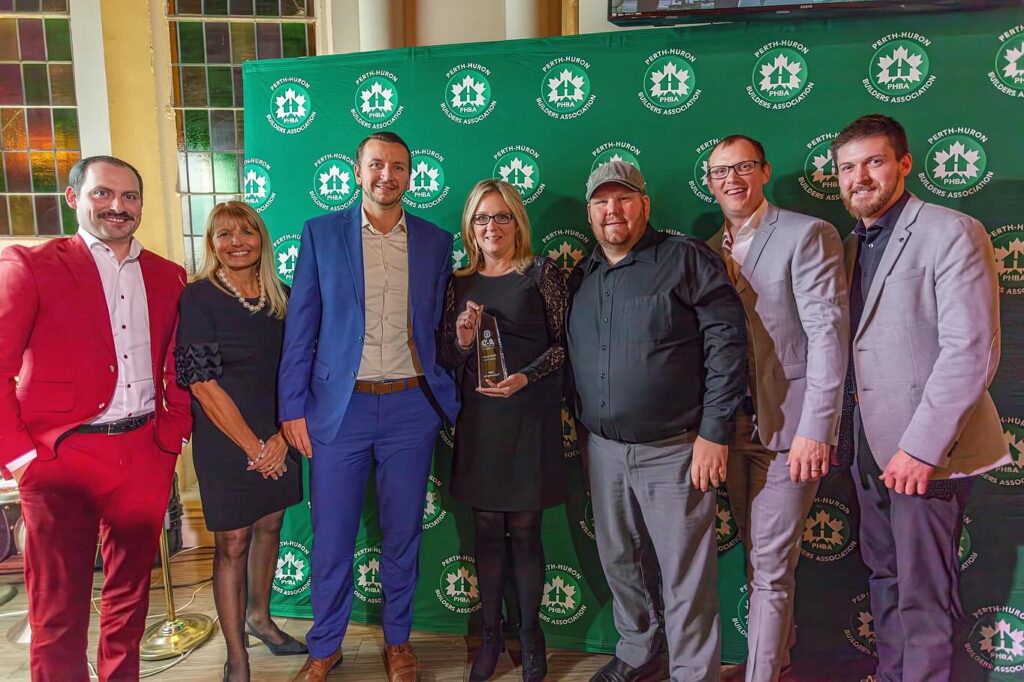
Over time, GRIT did gain recognition within the profession. They were the first firm to win the Ontario Home Builders’ Association Professional Services Award. They received ACEC-Ontario’s Internal Innovation Award for Philanthropy and Community Engagement. They were recognized locally by their Chamber of Commerce. Each brought visibility, but none changed the original intent.
The most important value of awards continued to show up long before any announcement was made.
The Moment That Matters Most
For GRIT, the most meaningful part of the awards process happens before anything is submitted.
When leadership looks at a completed project and says to a project manager or junior engineer, “This work is worth putting forward,” something shifts. That moment reframes the project and the person behind it, as worthy of pause and recognition.
“You can even use the application itself as recognition,” Wilson explains. “You’re pulling someone into the process and saying, ‘This project you worked on really mattered.’ Even if you don’t win, that recognition is there.”
In consulting engineering, those moments are rare. Work moves quickly. Success is often measured by what is finished and what comes next. GRIT uses awards as a reason to slow that momentum just enough to acknowledge effort, judgment, and care, particularly for people who might otherwise stay quietly in the background.
Creating Space to Pause and Celebrate
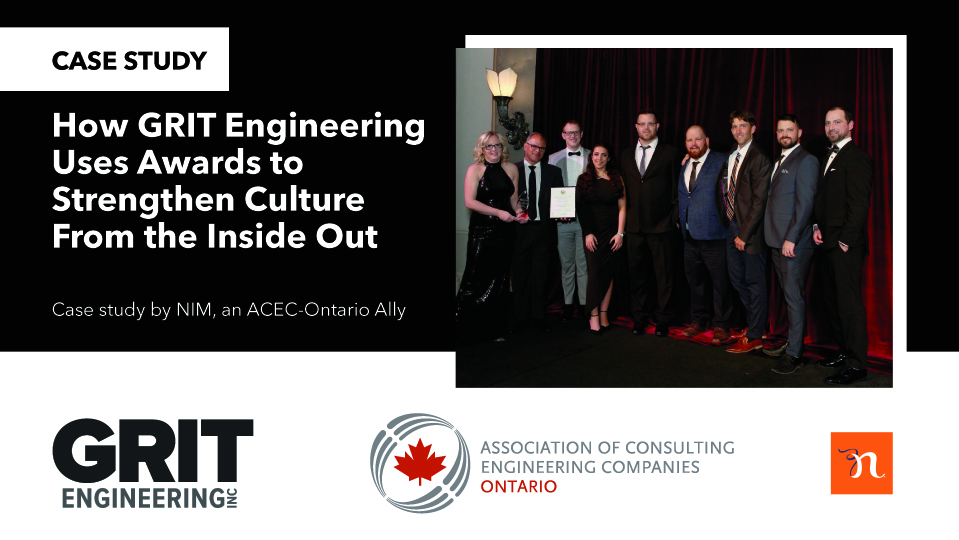
When GRIT received the ACEC-Ontario’s Internal Innovation – Philanthropy and Community Engagement Award, the response was deliberate and collective. The entire team attended the gala together. It was not treated as a symbolic win for leadership, but as a shared milestone.
“It was a really great team-building experience,” Wilson says. “A chance to pause and take note of what we accomplished.”
That pause matters. In a profession built around constant delivery, awards create a legitimate reason to stop, reflect, and celebrate as a group. They turn recognition into shared memory rather than a static asset on a website or a slide in a proposal deck.
For GRIT, celebration is not an afterthought. It is part of how the firm sustains energy and cohesion.

How Recognition Shows Up Day to Day
Internally, awards have become woven into how GRIT maintains momentum and morale. Wins are shared openly. Success is acknowledged publicly, not quietly absorbed and forgotten.
“If we stopped pursuing awards,” Wilson reflects, “we’d lose excitement around the office. People here are passionate. They like celebrating the work they do.”
That excitement matters. Recognition at GRIT reinforces pride and connection without creating unhealthy competition or performance pressure. It reminds people that their work is seen and valued, even when outcomes are not flashy or high-profile.
The Downstream Effects on Clients and Recruitment
Awards have also supported GRIT externally, particularly as a young firm operating alongside much larger engineering firms. Recognition helps establish credibility and shorten trust-building conversations with clients who may be encountering the firm for the first time.
Recruitment benefits are more subtle, but no less real. Candidates rarely point to awards directly. Instead, they talk about values such as community involvement, flexibility, care for people, and leadership accessibility. Awards reinforce those signals precisely because they reflect what already exists inside the firm. They act as proof, not a promise.
Making the Process Sustainable
Award submissions at GRIT are handled by administrative staff with leadership involvement. The process is kept efficient and realistic, supported by technology where it makes sense.
Crucially, submissions are treated as manageable, not monumental. Over time, award programs have become more streamlined, and GRIT approaches them as an exercise in capturing work already done rather than manufacturing new narratives. The effort typically amounts to a few focused hours, not weeks of disruption.
For Wilson, that balance matters. The time invested is intentional, but it is never disproportionate. The return in morale, pride, and shared recognition consistently justifies the effort.
Using Awards with Cultural Intent
GRIT built its approach to awards on top of a strong culture, not in place of one. At the same time, Wilson recognizes that not every firm starts from the same position.
For leaders who believe culture matters but struggle to make it tangible, awards offer a realistic way to take that commitment seriously. When used thoughtfully, the act of recognizing work, involving people in submissions, and celebrating effort can become a meaningful cultural lever, one that reinforces values rather than merely stating them.
“If you want to improve your culture, applying for awards and celebrating each other is definitely a way to do that,” Wilson says. “Even if you don’t win.”
Recognition, in this context, becomes a way to draw people in, give quieter contributors visibility, and create moments of leadership attention that might not otherwise exist.
A Practical Example for Other Small Firms
Awards can easily become performative. Many firms use them that way. GRIT chose a more disciplined path, using awards as a reason to slow down, recognize effort, and reinforce the kind of workplace they want to sustain.
For small consulting engineering firms that say culture matters, GRIT offers a grounded example of what that belief looks like when it is taken seriously.