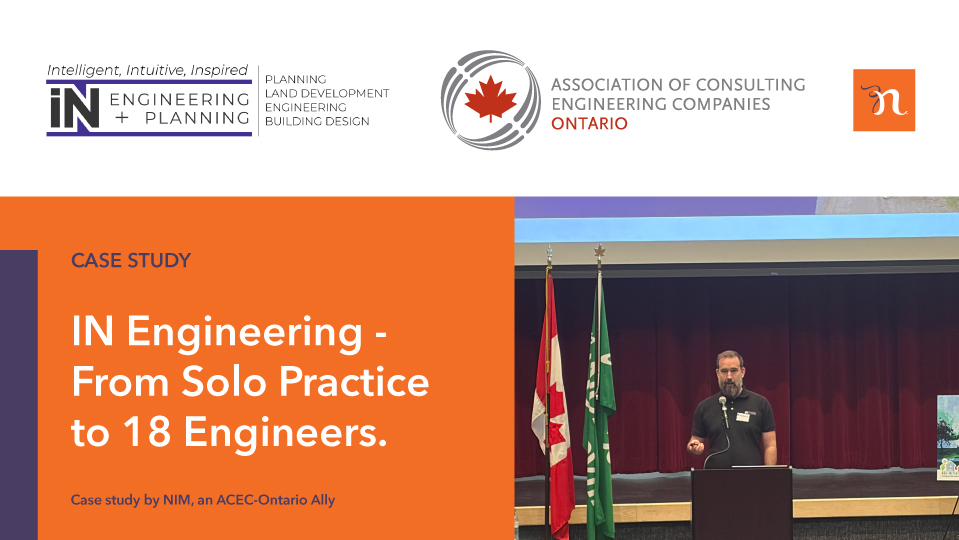
When Andrew Melchers launched IN Engineering in 2018, he faced the problem every new firm in a smaller market faces: a well-established competitor already had the name recognition, the relationships, and the benefit of the doubt. In Brockville, people tend to call the firm they already know.
Melchers decided not to wait to be discovered. He built his business around making the firm easy to find, credible to consider, and worth choosing, starting before he had the track record to rely on.
Six years later, IN Engineering has grown from one person to eighteen, expanded its reach across Eastern Ontario, and acquired and grown a surveying practice. The early marketing decisions played a significant role in that.
An Opening Established Firms Ignored
Before starting IN Engineering, Melchers had observed something consistent across the smaller engineering firms he knew: most had dated websites, weak search visibility, and little online presence. They relied on history and reputation, and mostly, that was enough. But it meant they had ceded a channel that a new firm could exploit.
He made that a founding priority. From the beginning, he invested in a well-built website, search engine optimization, and consistent social media activity. As he explained:
“I knew if I could dominate local search engine results through really good web design and search engine optimization, and if I just embraced social media, I could get my name out there really quickly and really cheaply as well.”
Within roughly six months, he had more work than he could handle on his own. The channel worked because no one else was using it seriously.
Credibility Before the Call
What a current website and active online presence actually do is reduce doubt. Clients make judgments long before they speak to a firm. They ask whether the company looks active, whether it handles the kind of work they need, and whether it seems like a serious operation. For a younger firm without a long track record, those questions are more consequential, not less.
IN Engineering used its website, project writeups, and consistent public presence to answer those questions before anyone picked up the phone. That let the company look established sooner than its age would normally allow. Prospective clients could see the firm’s work, how it approached projects, and the level of service it aimed to deliver.
In engineering, clients are not just purchasing a service. They are choosing risk. The firm that helps them feel confident before the first conversation has already gained ground.
From Personal Effort to a Working System
In the early years, Melchers did everything himself: engineering work, drafting, site visits, sales, and keeping the firm visible. That pace was sustainable for a while.
As the firm grew, project demands increased and marketing became harder to sustain. Melchers was direct about what happened: “I was too busy on projects. I didn’t really focus on it.”
That is where many firms stop. The work becomes occasional. It gets done when someone remembers, then fades when they do not.
Melchers built a system instead. He used tools like Zapier and Buffer to schedule and automate posting, and later used AI to accelerate drafting and content development. The shift was less about the technology than the discipline. Marketing stopped being something he fit in around the real work and became part of how the business operated.
Posting More Is Not the Same as Saying Something
One of the more useful lessons from this story is that Melchers did not assume that volume equals value. He found that out the hard way.
At one point, he had automated daily posting. The firm was active. But the content had become repetitive, and repetitive content does not do much. He adjusted. The mix shifted toward material grounded in actual work: project examples, industry commentary, hiring updates, and explanations that helped clients understand what engineers actually do.
That educational angle proved important. Many clients do not follow what happens between a permit drawing and construction. Melchers described the gap publicly. By explaining the difference between permit work and the deeper technical effort required before and during a build, the firm did more than promote itself. It helped clients understand what they were buying.
A better-informed client is generally a better client.
More Inquiries, More Choice
In the early years, IN Engineering took on almost everything. That is what most young firms do. When the next project is uncertain, saying yes feels safer than saying no.
That changed as the business became better known. A stronger online presence brought in more inquiries and expanded the firm’s reach well beyond the immediate Brockville area into other parts of Eastern Ontario. Over time, that gave the company something it did not have at the start: room to choose.
Melchers described the shift plainly. If a prospective client thinks the firm is too detailed or too expensive, that is fine. The company no longer has to shape itself around every inquiry. It can focus on the level of work it wants to do and the standard of service it believes in. Moving from chasing work to screening it is a meaningful business outcome.
The Public Presence Helped With Hiring
Service firms grow through people. More demand only creates capacity problems if the business cannot attract the right staff.
IN Engineering found that its public presence helped there as well. Candidates could see what kinds of projects the firm handled and what kind of company it was before deciding whether to apply. Melchers noted that candidates have specifically mentioned the firm’s online activity and project work as reasons they wanted to come aboard.
Firms that treat recruiting and marketing as separate functions miss this. A firm’s public presence shapes how prospective employees assess it. It tells them whether the company is active, worth joining, and doing work they want to be part of.
Visibility Shapes Proposal Outcomes
Engineering firms often argue that marketing matters less in their world because most work comes through referrals or formal proposals. That argument misunderstands how decisions are actually made.
Technical qualifications matter. Proposal quality matters. Referrals matter. Familiarity also matters. A firm that has been showing up consistently in the market and consistently demonstrating its work is easier to trust than one that seems invisible. Melchers described a municipal project in which the project manager told him they had regularly seen the firm’s work online and already knew it was doing good work. That kind of recognition rarely appears in an evaluation matrix. It still affects how people assess credibility.
That is the real function marketing can serve in proposal-driven work. It does not replace technical capability. It makes the firm feel known before the proposal is even opened.
The Same Approach Worked Twice
In 2020, Melchers acquired and merged with Collett Surveying Ltd. The surveying profession, like engineering, had underinvested in public presence for years. He applied the same approach: a stronger website, better search visibility, consistent activity, and content that helped clients understand the work.
Revenue at Collett increased fivefold over two years.
That matters because it confirms the underlying capability was not a one-time result tied to a specific market or moment. It was repeatable. Melchers had found a practical way to help firms get found, earn trust faster, and compete more effectively against older businesses that had grown accustomed to being the obvious choice.
AI Accelerates the Work. Judgment Still Drives It.
More recently, IN Engineering has added AI to its workflow. The time savings are real. Generating ideas, drafting posts, and turning rough notes into usable content all happen faster.
Even so, the firm’s judgment still drives what gets made. AI does not decide what is worth saying. It does not understand what a particular client needs clarified, which project story deserves to be told, or what tone fits the company’s position in the market. It cannot assess technical accuracy or recognize when a piece of content will land well with the audience that matters.
This case is ultimately less about tools than it is about intention. The tools helped. The decision to treat marketing as a business function, not an afterthought, mattered more.
What This Means for Engineering Firm Leaders
IN Engineering did not become a serious competitor by waiting for the market to find it.
It earned attention early. It made itself easier to find. It gave prospective clients reasons to trust it before the first conversation. It kept showing up while more established firms were harder to read and slower to adapt. Then it built systems that kept that work going as the business grew.
The firm went from one person to eighteen. Its reach expanded well beyond its original market. It gained the ability to turn away work that did not fit. It attracted better hires. It outperformed expectations in an acquisition.
Good work still matters most. Reputation still matters. Referrals still matter.
But a firm that is hard to find, hard to understand, and easy to overlook makes growth harder than it has to be.